
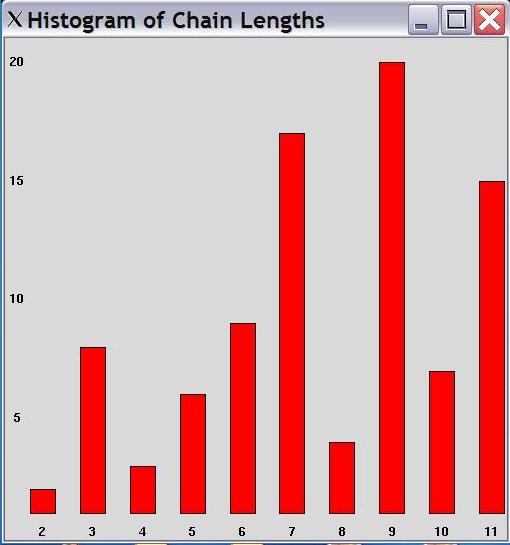
I want to draw a histogram of 2-11 and each bar of the number would reach up to the chain length of that number.
I have a hailstone sequence as given below
but how can i draw a histogram of 2-11 and each bar of the number would reach up to the chain length of that number inside this hailstone sequence.
I have a hailstone sequence as given below
Code:
import string
# from graphics import *
from graphics import *

#Constant
MAX = 10000

# printing functions

# this function prints a brief description of the program to the user
# Inputs: none
# Outputs : none
def printGreeting():
    print ""
    print " This program finds hailstones sequences of numbers"
    print " you choose. The next number in the sequence if found by"
    print " either dividing it by two(if even) or multiplying by 3"
    print " and adding 1(if odd).The program quits when the last"
    print " number in the sequence is 1\n"

# this functions prints the menu for the user
# Inputs: none
# Outputs : none
def printMenu():
    print "\n\tHere are your menu choices:"
    print "\n\tI - view squence for an individual value\n"
    print "\tR - veiw sequence for range of values\n"
    print "\tL - Find the longest chain\n"
    print "\tH - Print out the histogram\n"
    print "\tQ - Quit\n\n"

# end of printing funtions


# hailstone(number) prints the hailstone sequence
# Inputs: number
# Outputs: none
def hailstone(n):

    length = 1
    print n,
    # checks if n is not sential
    while n != 1:

        # if even, divide by 2 (rule). add 1 to length
        if n % 2 == 0:
            n = n / 2
            print "->",n,
            length = length + 1

        # if odd, multiply by 3, add 1 (rule). add 1 to length
        elif n % 2 != 0:
            n = ( 3 * n ) + 1
            print "->",n,
            length = length + 1

    # print the length at the end of each chain
    print "; length =",length
    print "----------------------------------------------------------------",
    print "--------------\n"
    return length

# this function returns the length of each chain from the starting number, n
# Inputs : n
# Outputs : none
def chain(n):

    length = 1
    while n != 1:

        # if even, divide by 2 (rule). add 1 to length
        if n % 2 == 0:
            n = n / 2
            length  = length + 1

        # if even, divide by 2 (rule). add 1 to length
        elif n % 2 != 0:
            n = ( 3 * n ) + 1
            length = length + 1
    return length

# getValidInt() prompts the user to enter an integer in the specified range,
# rejects values not in that range by requiring new input, and only returns
# a valid integer.
# Inputs: the question of the prompt,
#         the minimum value in the range
#         and the maximum value in the range
# Output: an integer in the specified range
def getValidInt(question, min, max):

    # use a bad value to enter the loop
    value = max + 1

    # compose the prompt
    prompt = question + " (" + str(min) + "-" + str(max) + "): "

    # continue to get values until the user enters a valid one
    while value == "" or value < min or value > max:
        value = raw_input(prompt)
        if len(value) != 0:
            value = int(value)

    # return a valid value
    return value


# this function finds the longest chain
# Inputs: none
# Outputs : none
def longChain():
     begin = "Please enter the begining integer for the range"
     end = "Please enter the ending integer for the range"

     # calls to getValidInt for starting and ending values
     beginNum = getValidInt(begin, 1, MAX)
     endNum = getValidInt(end, beginNum + 1, MAX)

     largestChain = beginNum

     for i in range(beginNum, endNum+1):
         if largestChain <= chain(i):
             largestChain = i
             length = chain(i)

     print largestChain, " had the longest chain ", length

# this function finds the longest chain***************************8
# Inputs: none*************
# Outputs : none
def histogram():
    # initialize variables
    longestLength = 1
    list = []

    start = input("Please enter the begining integer for the range: ")
    for n in range (start, start + 10):
        length = chain(n)
        list.append(length)
        if longestLength <= chain(n):
            longestLength = n
            length = chain(n)
        print longestLength
        print list

def main():

    # prints the greeting to the user
    printGreeting()

    # prints the menu to the user
    printMenu()

    # asks user the menu choice
    choice = raw_input("Please enter your choice : ").upper()

    # checks to see if choice entered is from the menu
    while choice != 'Q':

        # if choice is "I" or "i", proceeds to follow the individual steps
        if choice == 'I':
            n = input("Please enter your integer (1-10000):")
            hailstone(n)

        # if choice is "R" or "r", proceds print each number and its sequence
        # until the last number is 1, uses getValidInt to get valid integers
        # for the function
        elif choice == 'R':

            begin = "Please enter the begining integer for the range"
            end = "Please enter the ending integer for the range"

            # calls to getValidInt for starting and ending values
            beginNum = getValidInt(begin, 1, MAX)
            endNum = getValidInt(end, beginNum + 1, MAX)

            # for loop to get the values between starting and ending value
            for n in range(beginNum,endNum+1):

                #call to the hailstone function
                hailstone(n)

        # if choice is "L" or "l", proceeds to use getValidInt again to get the
        # range, error checks on the range, and then calls the function chain
        # to determine the length.
        elif choice == 'L':
            # call to function longchain
            longChain()

        elif choice == 'H':
            histogram()

        # if niether of the menu choices, then it prints that the
        # entered text is not a valid choices
        else:
            print choice, "is not a valid choice"

        # prints the menu to the user
        printMenu()

        # asks user the menu choice
        choice = raw_input("Please enter your choice : ").upper()

main()



Comment