
Can a low-level programmer learn OOP?

Collapse
This topic is closed.
X
X
 
  • Time
  • Show
Clear All
new posts
  • darren kirby

    #31
    Re: Can a low-level programmer learn OOP?

    quoth the Wayne Brehaut:
    (I started with Royal McBee LGP 30 machine language (hex input) in
    1958, and their ACT IV assembler later! Then FORTRAN IV in 1965. By
    1967 I too was using (Burroughs) Algol-60, and 10 years later upgraded
    to (DEC-10) Simula-67.)
    >
    Going---going---
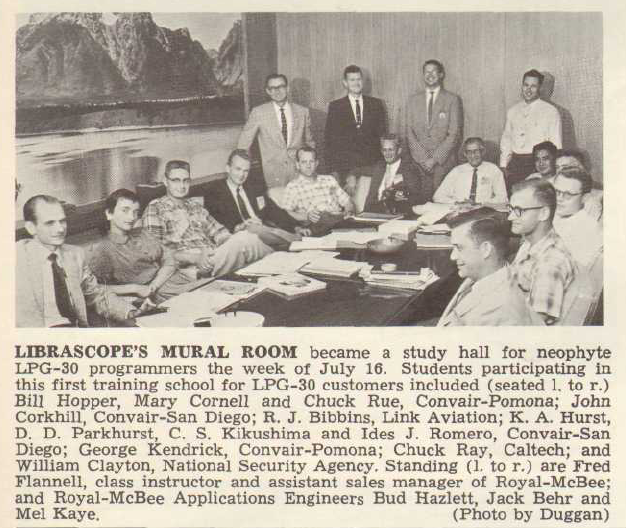
    Mel? Is that you?


    -d
    --
    darren kirby :: Part of the problem since 1976 :: http://badcomputer.org
    "...the number of UNIX installations has grown to 10, with more expected..."
    - Dennis Ritchie and Ken Thompson, June 1972

    Comment

    • Wayne Brehaut

      #32
      Re: Can a low-level programmer learn OOP?

      On Sat, 14 Jul 2007 19:18:05 +0530, "Rustom Mody"
      <rustompmody@gm ail.comwrote:
      >On 7/14/07, Alex Martelli <aleax@mac.comw rote:
      >>
      >OOP can be abused (particularly with deep or intricate inheritance
      >structures). But the base concept is simple and clear: you can bundle
      >state and behavior into a stateful "black box" (of which you may make as
      >many instances, with independent state but equal behavior, as you need).
      >>
      >
      >Many years ago (86??) Wegner wrote a paper in OOPSLA called Dimensions
      >of Object Orientation in which he called the 'base concept' of 'bundle
      >of state and behavior' as 'object based' programming and
      >'object-oriented' as object-based + inheritance.
      Not quite--according to him:

      object-based + classes =class-based
      class-based + class inheritance =object-oriented

      I.e., "object-oriented = objects + classes + inheritance".

      This was not the, by then, standard definition: to be OO would require
      all four of:

      1. modularity (class-based? object-based?)
      2. inheritance (sub-classing)
      3. encapsulation (information hiding)
      4. polymorphism ((sub-) class-specific response to a message, or
      processing of a method)

      Unfortunately, most of the "definition s" (usually just hand-waving,
      loosey-goosey descriptions) found on the web include none--or only one
      or two--of these fundamental requirements by name, and are so loose
      that almost any proramming paradigm or style would be OO.
      >What Alex is saying is (in effect) that object-based is simple and
      >clear (and useful) whereas the object-orientation is subject to abuse.
      But OO is also simple and clear (if clearly defined and explained and
      illustrated and implemented), and ANY programming style is subject to
      abuse. During the hey-day of Pascal as an introductory programming
      language (as often misused as more than that) I found many often
      spent much of their time defining the data types their program would
      use.
      >This anyway is my experience: C++ programmers are distinctly poorer
      >programmers than C programmers -- for some strange reason closeness to
      >the machine has a salutary effect whereas the encouragment of
      >uselessly over-engineered programs makes worse programmers.
      But this is a tautology: "over-engineered" programs are, by definition
      or terminology, not a good thing--independent of what PL or style
      they're finally implemented in (assuming that by "engineerin g" you
      mean "design" or similar). Many of my Pascal students over-engineered
      their solutions to simple problems too?
      >GUI is one of those cases wherein inheritance actually helps people
      >produce better code but this is something of an exception.
      This seems to imply that the list of applications you have in mind or
      have worked on includes fewer domains that might profit from full OO
      instead of just OB. My guess is that there are many application
      domains in which analysts and programmers often think in an "OO way",
      but implement in just an OB way because of the PL they or their
      employer requires or prefers: in some--perhaps many--of these cases
      they have to do "manually" what OO would have automated.

      There is a problem, though, of (especially university and college)
      education and training in OOP "talking about" how glorious OO is, and
      requiring students to use OO techniques whether they're most
      appropriate or not (the "classes early" pedagogical mindset). And
      this problem is compounded by teaching introductory programming using
      a language like Java that requires one to use an OO style for even
      trivial programs. And by using one of the many very similar
      introductory texbooks that talk a lot about OO before actually getting
      started on programming, so students don't realize how trivial a
      program is required to solve a trivial problem, and hence look for
      complexity everywhere--whether it exists or not--and spend a lot of
      time supposedly reducing the complexity of an already simple problem
      and its method of solution.

      But as I noted above, a similar problem occurred with the crop of
      students who first learned Pascal: they often spent much of their time
      defining the data types their program would use, just as OO
      (especially "classes early") graduates tend to waste time
      "over-subclassing" and developing libraries of little-used classes.

      The answer is always balance, and having an extensive enough toolkit
      that one is not forced or encouraged to apply a programming model that
      isn't appropriate and doesn't help in any way (including
      maintainability ). And starting with a language that doesn't brainwash
      one into believing that the style it enforces or implies is always the
      best--and texbooks that teach proper choice of programming style
      instead of rigid adherence to one.

      wwwayne

      Comment

      • Wayne Brehaut

        #33
        Re: Can a low-level programmer learn OOP?

        On Sat, 14 Jul 2007 11:49:48 -0600, darren kirby
        <bulliver@badco mputer.orgwrote :
        >quoth the Wayne Brehaut:
        >
        >(I started with Royal McBee LGP 30 machine language (hex input) in
        >1958, and their ACT IV assembler later! Then FORTRAN IV in 1965. By
        >1967 I too was using (Burroughs) Algol-60, and 10 years later upgraded
        >to (DEC-10) Simula-67.)
        >>
        >Going---going---
        >
        >Mel? Is that you?
        >
        >http://www.pbm.com/~lindahl/mel.html
        >
        Ha-ha! Thanks for that!

        Although I'm not Mel, the first program I saw running on the LGP-30
        was his Blackjack program! In 1958 I took a Numerical Methods course
        at the University of Saskatchewan, and we got to program Newton's
        forward difference method for the LGP-30. Our "computer centre tour"
        was to the attic of the Physics building, where their LGP-30 was
        networked to a similar one at the Univeristy of Toronto (the first
        educational computer network in Canada!), and the operator played a
        few hands of Blackjack with the operator there to illustrate how
        useful computers could be.

        A few years later, as a telecommunicati ons officer in the RCAF, I
        helped design (but never got to teach :-( ) a course in LGP-30
        architecture and programming using both ML and ACT IV AL, complete
        with paper tape input and Charactron Tube
        (http://en.wikipedia.org/wiki/Charactron) output--handy, since this
        display was also used in the SAGE system.

        We weren't encouraged to use card games as examples, so used
        navigational and tracking problems involving fairly simple
        trigonometry.

        wwwayne
        >-d

        Comment

        • Sebastian Bassi

          #34
          Re: Can a low-level programmer learn OOP?

          On 7/13/07, Simon Hibbs <simon.hibbs@gm ail.comwrote:
          place. At the end of it you'll have a good idea how OOP works, and how
          Python works. Learning OOp this way is easy and painless, and what you
          ...

          But this tutorial states "I assume you know how object-oriented
          programming works"

          --
          Sebastián Bassi (セバステ゠£ã‚¢ãƒ³)
          Diplomado en Ciencia y Tecnología.
          GPG Fingerprint: 9470 0980 620D ABFC BE63 A4A4 A3DE C97D 8422 D43D

          Comment

          • bonnie@macbird.com

            #35
            Re: Can a low-level programmer learn OOP?

            On Jul 13, 3:20 pm, Wayne Brehaut <wbreh...@mcsne t.cawrote:
            On Sat, 14 Jul 2007 06:01:56 +0200, Bruno Desthuilliers
            >
            <bdesth.quelque ch...@free.quel quepart.frwrote :
            Chris Carlen a écrit :
            Hi:
            >
            From what I've read of OOP, I don't get it. I have also found some
            articles profoundly critical of OOP. I tend to relate to these articles.
            >
            === 8< ===
            >
            >
            >
            Hence, being a hardware designer rather than a computer scientist, I am
            conditioned to think like a machine. I think this is the main reason
            why OOP has always repelled me.
            >
            OTOH, OO is about machines - at least as conceveid by Alan Key, who
            invented the term and most of the concept. According to him, each object
            is a (simulation of) a small machine.
            >
            Oh you young'uns, not versed in The Ancient Lore, but filled with
            self-serving propaganda from Xerox PARC,Alan Kay, and Smalltalk
            adherents everywhere!
            >
            As a few more enlightened have noted in more than one thread here, the
            Mother of All OOP was Simula (then known as SIMULA 67). AllAlan Kay
            did was define "OOPL", but then didn't notice (apparently--though this
            may have been a "convenient oversight") that Simula satisfied all the
            criteria so was actually the first OOPL--and at least 10 years earlier
            than Smalltalk!
            >
            So Kay actually invented NONE of the concepts that make a PL an OOPL.
            He only stated the concepts concisely and named the result OOP, and
            invented yet another implementation of the concepts-- based on a
            LISP-like functional syntax instead of an Algol-60 procedural syntax,
            and using message-passing for communication amongst objects (and
            assumed a GUI-based IDE) (and introduced some new terminology,
            especially use of the term "method" to distinguish class and instance
            procedures and functions, which Simula hadn't done) .
            >
            As Randy Gest notes onhttp://www.smalltalk.o rg/alankay.html, "The
            major ideas in Smalltalk are generally credited toAlan Kaywith many
            roots in Simula, LISP and SketchPad." Too many seem to assume that
            some of these other "features" of Smalltalk are part of the definition
            of an OOP, and so are misled into believing the claim that it was the
            first OOPL. Or they claim that certain deficiencies in Simula's object
            model--as compared to Smalltalk's--somehow disqualifies it as a "true
            OOPL", even though it satisfies all the criteria as stated by Kay in
            his definition. Seehttp://en.wikipedia.or g/wiki/Simulaand related
            pages, and "The History of Programming Languages I (HOPL I)", for
            more details.
            >
            Under a claim of Academic Impunity (or was that "Immunity") , here's
            another historical tid-bit. In a previous empolyment we once had a
            faculty applicant from CalTech who knew we were using Simula as our
            introductory and core language in our CS program, so he visited Xerox
            PARC before coming for his inteview. His estimate ofAlan Kayand
            Smalltalk at that time (early 80s) was that "They wanted to implement
            Simula but didn't understand it--so they invented Smalltalk and now
            don't understand _it_!"
            >
            wwwayne
            >
            === 8< ===
            A couple of notes on this post.

            Alan Kay has always publicly credited Simula as the direct inspiration
            for Smalltalk, and if you know the man and his work, this implication
            of taking credit for the first OOP language is not true, it is a
            credit assigned to him by others, and one which he usually rights when
            confronted with it.

            You may be confused with the fact that "object oriented
            programming"was a term which I believe was first used by Alan and his
            group at PARC, so perhaps the coining of the term is what is being
            referenced by others.

            Perhaps I'm mistaken, but the tone of your post conveys an animosity
            that did not exist between the original Smalltalk and Simula
            inventors; Nygard and Kay were good friends, and admired each others'
            work very much.


            Bonnie MacBird


            Comment

            • Wayne Brehaut

              #36
              Re: Can a low-level programmer learn OOP?

              On Sun, 15 Jul 2007 07:47:20 -0000, bonnie@macbird. com wrote:
              >On Jul 13, 3:20 pm, Wayne Brehaut <wbreh...@mcsne t.cawrote:
              >On Sat, 14 Jul 2007 06:01:56 +0200, Bruno Desthuilliers
              >>
              ><bdesth.quelqu ech...@free.que lquepart.frwrot e:
              >Chris Carlen a écrit :
              >Hi:
              >>
              > From what I've read of OOP, I don't get it. I have also found some
              >articles profoundly critical of OOP. I tend to relate to these articles.
              >>
              >=== 8< ===
              === 8< ===
              >Under a claim of Academic Impunity (or was that "Immunity") , here's
              >another historical tid-bit. In a previous empolyment we once had a
              >faculty applicant from CalTech who knew we were using Simula as our
              >introductory and core language in our CS program, so he visited Xerox
              >PARC before coming for his inteview. His estimate ofAlan Kayand
              >Smalltalk at that time (early 80s) was that "They wanted to implement
              >Simula but didn't understand it--so they invented Smalltalk and now
              >don't understand _it_!"
              >>
              >wwwayne
              >>
              >=== 8< ===
              >
              >A couple of notes on this post.
              >
              >Alan Kay has always publicly credited Simula as the direct inspiration
              >for Smalltalk, and if you know the man and his work, this implication
              >of taking credit for the first OOP language is not true, it is a
              >credit assigned to him by others, and one which he usually rights when
              >confronted with it.
              I know this, and was perhaps a little too flippant in my all-inclusive
              statement "self-serving propaganda from Xerox PARC,Alan Kay, and
              Smalltalk adherents everywhere!", for which I apologize. But it was
              made with humorous intent, as I had hoped the opening "Oh you
              young'uns, not versed in The Ancient Lore, but filled with
              self-serving propaganda..." would imply.

              A more accurate and unhumorous statement of my opinion is that it is
              Smalltalk adherents who know virtually nothing of the history of
              OOP--and even some who do--who did and still do make such claims,
              both personally and in the published literature of OOP.

              And my statement about a prospective faculty member's opinion was just
              that: a historical anecdote, and the expression of an early 80s
              opinion by a professional CS professor and researcher in formal
              semantics (which may have been part of his distrust of the Smalltalk
              team's "understand ing" of Smalltalk) . The opinion he expressed was
              his and not my own, and I was just recording (what I thought might
              be) an amusing anecdote in a context in which I thought it
              appropriate: discussion of what OOP is, and after Bruno made the
              claim: "OO is about machines - at least as conceveid by Alan Key, who
              invented the term and most of the concept." I don't think my
              recording it here should be construed as my opinion of either
              Smalltalk or its creators (at that time or now).

              As often happens in many arenas, the creator of an idea can lose
              control to the flock, and many publications can get accepted if
              referrees themselves don't know the facts or take care to check them
              before recommending publication--which probably explains why so many
              publications (especially in conference proceedings) on OOP in the 80s
              and 90s completely omitted any mention of Simula: so much so that I
              once intended writing a paper on "Ignorance of Simula Considered
              Harmful."

              On the other hand, anytyhing you may have inferred about my distaste
              for those who doesn't bother to learn anything of the history of a
              subject, then make false or misleading claims, and don't bother to
              correct themselves when questioned, is true.
              >You may be confused with the fact that "object oriented
              >programming"wa s a term which I believe was first used by Alan and his
              >group at PARC, so perhaps the coining of the term is what is being
              >referenced by others.
              No, I have been at more than one CS (or related area) conference where
              a Smalltalk aficionado has stated unequivocally that Kay invented OOP
              and that Smalltalk was the first OOPL. The last I recall for sure was
              WebNet 2000, where a (quite young) presenter on Squeak made that
              statement, and was not at all certain what Simula was when I asked
              whether it might actually have been the first more than 10 years
              before Smalltalk 80. So his claim, and that of many others,
              explicitly or implicitly, is that not only the term, but most (or all)
              of the concept, and (often) the first implementation of OOP was by Kay
              and his Xerox PARC team in Smalltalk 80.
              >Perhaps I'm mistaken, but the tone of your post conveys an animosity
              >that did not exist between the original Smalltalk and Simula
              >inventors; Nygard and Kay were good friends, and admired each others'
              >work very much.
              Yes, you are very much mistaken (as I note above), and appear not to
              have understood the intended humorous tone of my posting.

              wwwayne
              >
              >Bonnie MacBird
              >

              Comment

              • Paddy

                #37
                Re: Can a low-level programmer learn OOP?

                On Jul 13, 5:06 pm, Chris Carlen <crcarleRemoveT ...@BOGUSsandia .gov>
                wrote:
                Hi:
                Christopher
                >
                Problem:
                >
                1. How to most easily learn to write simple PC GUI programs that will
                send data to remote embedded devices via serial comms, and perhaps
                incorporate some basic (x,y) type graphics display and manipulation
                (simple drawing program). Data may result from user GUI input, or from
                parsing a text config file. Solution need not be efficient in machine
                resource utilization. Emphasis is on quickness with which programmer
                can learn and implement solution.
                Have you also tried looking for a cross-platform GUI program that has
                a
                scripting interface that you might adapt? If found then the extra
                scripting needs may be reduced.

                - Paddy.

                Comment

                • Aahz

                  #38
                  Re: Can a low-level programmer learn OOP?

                  In article <om_li.21868$RX .20941@newssvr1 1.news.prodigy. net>,
                  James Stroud <jstroud@mbi.uc la.eduwrote:
                  >
                  >If you just want to enter some values and set some flags and then hit
                  >"go", you could always program the GUI in HTML and have a cgi script
                  >process the result. This has a lot of benefits that are frequently
                  >overlooked but tend to be less fun than using a bona-fide toolkit like
                  >WX or QT.
                  This is excellent advice worth emphasizing -- but then, I make my living
                  working on a web app. ;-)
                  --
                  Aahz (aahz@pythoncra ft.com) <* http://www.pythoncraft.com/

                  I support the RKAB

                  Comment

                  • Bruno Desthuilliers

                    #39
                    Re: Can a low-level programmer learn OOP?

                    Wayne Brehaut a écrit :
                    On Sat, 14 Jul 2007 06:01:56 +0200, Bruno Desthuilliers
                    <bdesth.quelque chose@free.quel quepart.frwrote :
                    >
                    >Chris Carlen a écrit :
                    >>Hi:
                    >>>
                    >> From what I've read of OOP, I don't get it. I have also found some
                    >>articles profoundly critical of OOP. I tend to relate to these articles.
                    >>>
                    >
                    === 8< ===
                    >
                    >>Hence, being a hardware designer rather than a computer scientist, I am
                    >>conditioned to think like a machine. I think this is the main reason
                    >>why OOP has always repelled me.
                    >OTOH, OO is about machines - at least as conceveid by Alan Key, who
                    >invented the term and most of the concept. According to him, each object
                    >is a (simulation of) a small machine.
                    >
                    Oh you young'uns, not versed in The Ancient Lore, but filled with
                    self-serving propaganda from Xerox PARC, Alan Kay, and Smalltalk
                    adherents everywhere!
                    Not feeling concerned.

                    (snip pro-simula/anti-Xerox propaganda).

                    Comment

                    • Bruno Desthuilliers

                      #40
                      Re: Can a low-level programmer learn OOP?

                      Wayne Brehaut a écrit :
                      (snip)
                      after Bruno made the
                      claim: "OO is about machines - at least as conceveid by Alan Key, who
                      invented the term and most of the concept."
                      Please reread more carefully the above. I do give credit to Smalltalk's
                      author for the *term* "OOP", and *most* (not *all*) of the concepts (I
                      strongly disagree with your opinion that message-passing is not a core
                      concept of OO).

                      FWIW, I first mentionned Simula too (about the state-machine and
                      simulation aspect), then sniped this mention because I thought it was
                      getting a bit too much OT - we're not on comp.object here.

                      Comment

                      • hide1713@gmail.com

                        #41
                        Re: Can a low-level programmer learn OOP?

                        You are lucky.Our project is a cross-platform cluster computer
                        managment system
                        this system can run on both windows and Linux

                        I tell you how we solve this problems
                        >
                        1. How to most easily learn to write simple PC GUI programs that will
                        send data to remote embedded devices via serial comms, and perhaps
                        incorporate some basic (x,y) type graphics display and manipulation
                        (simple drawing program). Data may result from user GUI input, or from
                        parsing a text config file. Solution need not be efficient in machine
                        resource utilization. Emphasis is on quickness with which programmer
                        can learn and implement solution.
                        We use tk for GUI and we have a interpreter reads VB form file ".frm"
                        in and
                        display it with tk.You just need to draw forms in VB and save it in
                        frm formate
                        load it in your python file
                        LoadForm("aa.fr m")
                        after that you can use button,menu and so on in python

                        We use XMLRPC to conmunicate with remote node.XMLRPC is very cool for
                        you can
                        invoke a function in remote side in the same way you invoke a local
                        method.
                        for example
                        we have an remote object foo
                        foo.bar() #invoke bar() in remote side
                        but XMLRPC is work on network.I'm not sure it can work in serial
                        2. Must be cross-platform: Linux + Windows. This factor can have a big
                        impact on whether it is necessary to learn a new language, or stick with
                        C. If my platform was only Linux I could just learn GTK and be done
                        with it. I wouldn't be here in that case.
                        and most important is XMLRPC is cross-platform.you can use a linux for
                        server and windows for client


                        Comment

                        • Wayne Brehaut

                          #42
                          Re: Can a low-level programmer learn OOP?

                          On Mon, 16 Jul 2007 10:10:05 +0200, Bruno Desthuilliers
                          <bruno.42.desth uilliers@wtf.we bsiteburo.oops. comwrote:
                          >Wayne Brehaut a écrit :
                          >(snip)
                          after Bruno made the
                          >claim: "OO is about machines - at least as conceveid by Alan Key, who
                          >invented the term and most of the concept."
                          >
                          >Please reread more carefully the above. I do give credit to Smalltalk's
                          >author for the *term* "OOP", and *most* (not *all*) of the concepts (I
                          >strongly disagree with your opinion that message-passing is not a core
                          >concept of OO).
                          One problem is that it's often not clear what lists of properties are
                          his definition of OOP vs. what are the intended properties of
                          Smalltalk--his intended impelmentation of OOP. Many of the lists begin
                          with the basic requirements that "everything is an object" and
                          "objects communicate by message passing", but the most common
                          "generally agreed upon" definition abstracts just four requirements
                          from these (changing) lists--attempting to separate implementation
                          details from what is essential to the underlying framework. As I note
                          below, these were:

                          1. modularity (class-based? object-based?)
                          2. inheritance (sub-classing)
                          3. encapsulation (information hiding)
                          4. polymorphism ((sub-) class-specific response to a message, or
                          processing of a method)

                          Other details in Kay's lists are considered implementation details,
                          and important advances or alternatives to pevious methods, but not
                          required for a language to _be_ OO. It is reputed, though, that in
                          2003 Kay said
                          (http://c2.com/cgi/wiki?AlanKaysDefin...ObjectOriented) "OOP to
                          me means only messaging, local retention and protection and hiding of
                          state-process, and extreme LateBinding of all things."

                          So I understand your accepting one of Kay's lists as being a
                          definition of OOP instead of "just" a description of Smalltalk, or of
                          accepting this fairly recent "definition " as being the true one (as
                          opposed to the previous lists of usually 6 properties). "It's hard to
                          hit a moving target!"
                          >FWIW, I first mentionned Simula too (about the state-machine and
                          >simulation aspect), then sniped this mention because I thought it was
                          >getting a bit too much OT - we're not on comp.object here.
                          Understood--sort of--but there is sufficient accurate information
                          about Simula available on the web now that it's no longer necessary to
                          use quotes from Kay about OOP and Smalltalk just because they're more
                          accessible, as used to be the case. What would be so OT about
                          referring to Simulain one sentence instead of or in addition to
                          Smalltalk?

                          But I digress--my only real objection to your post was your opinion
                          and claim that Kay "invented the term and most of the concept": I've
                          never seen anyone claim that anyone else invented the term, but for
                          the claim that he invented "most of the concept" we need only refer to
                          Nygaard's claim in "How Object-Oriented Programming Started" at
                          http://heim.ifi.uio.no/~kristen/FORS..._OO_start.html
                          that "Simula 67 introduced most of the key concepts of object-oriented
                          programming: both objects and classes, subclasses (usually referred to
                          as inheritance) and virtual procedures, combined with safe referencing
                          and mechanisms for bringing into a program collections of program
                          structures described under a common class heading (prefixed blocks)."

                          Combine this with the fact--as stated above by Bonnie MacBird (Alan
                          Kay's significant other)--that "Alan Kay has always publicly credited
                          Simula as the direct inspiration for Smalltalk, and... this
                          implication of taking credit for the first OOP language is not true,
                          it is a credit assigned to him by others, and one which he usually
                          rights when confronted with it." If he acknowledges this perhaps
                          others should too?

                          As has been noted before, it's often the fact that a cause becomes a
                          religion: true believers tend to take it over from the originator, and
                          this religiosity tends to blind them from the facts. Opinions and
                          rumours become facts, stories are invented, definitions are changed or
                          twisted, and another religion is born! Even those who don't belong to
                          the religion cpme to believe the oft-repreated stories, and then help
                          spread and perpetuate them. (Continuing in my original humorous vein I
                          was tempted to use terms like "religious zealots", "false gospel",
                          "propaganda ", etc., but thought better of it in case I was again
                          misunderstood.)

                          Again, I disagree only with this one claim. You make significant
                          contributions to the group and to ellucidating Python and OOP to the
                          great unwashed: in contrast, all I've done so far is complain about
                          those who don't accept the correct (i.e., my) definition or use of
                          terms.

                          wwwayne

                          Comment

                          • Wayne Brehaut

                            #43
                            Re: Can a low-level programmer learn OOP?

                            On Mon, 16 Jul 2007 09:55:35 +0200, Bruno Desthuilliers
                            <bruno.42.desth uilliers@wtf.we bsiteburo.oops. comwrote:
                            >Wayne Brehaut a écrit :
                            >On Sat, 14 Jul 2007 06:01:56 +0200, Bruno Desthuilliers
                            ><bdesth.quelqu echose@free.que lquepart.frwrot e:
                            >>
                            >>Chris Carlen a écrit :
                            >>>Hi:
                            >>>>
                            >>> From what I've read of OOP, I don't get it. I have also found some
                            >>>articles profoundly critical of OOP. I tend to relate to these articles.
                            >>>>
                            >>
                            >=== 8< ===
                            >>
                            >>>Hence, being a hardware designer rather than a computer scientist, I am
                            >>>conditione d to think like a machine. I think this is the main reason
                            >>>why OOP has always repelled me.
                            >>OTOH, OO is about machines - at least as conceveid by Alan Key, who
                            >>invented the term and most of the concept. According to him, each object
                            >>is a (simulation of) a small machine.
                            >>
                            >Oh you young'uns, not versed in The Ancient Lore, but filled with
                            >self-serving propaganda from Xerox PARC, Alan Kay, and Smalltalk
                            >adherents everywhere!
                            >
                            >Not feeling concerned.
                            >
                            >(snip pro-simula/anti-Xerox propaganda).
                            Or, more accurately, pro:

                            1. Nygaard & Dahl as the inventors of most of the concept of OOP
                            2. Simula as the first OOP
                            3. Kay as the originator of the term OOP
                            4. Kay, Xerox PARC, and Smalltalk as making significant useful
                            advances in implementation of OOP and "popularizi ng" it

                            and anti:

                            1. attributing credit for any accomplishment to someone who doesn't
                            himself claim it and even denies it

                            wwwayne o/o

                            Comment

                            • Chris Carlen

                              #44
                              Re: Can a low-level programmer learn OOP?

                              Hendrik van Rooyen wrote:
                              "Chris Carlen" <crcarl,,,,dia. govwrote:
                              >>Form 2: Use Python and PySerial and TkInter or wxWidgets.
                              >>Pro: Cross-platform goal will likely be achieved fully. Have a
                              >>programmer nearby with extensive experience who can help.
                              >>Con: Must learn new language and library. Must possibly learn a
                              >>completely new way of thinking (OOP) not just a new language syntax.
                              >>This might be difficult.
                              This is the way to go. - Trust me on this.
                              When you describe your history, it is almost an exact parallel to mine.
                              In my case, I have been doing real low level stuff (mostly 8031 assembler)
                              since 1982 or so. And then I found python in a GSM module (Telit), and
                              I was intrigued.
                              I really appreciate your comments on OO - it parallels a lot of what I feel
                              as there is a lot of apparent BS that does not seem to "do anything" at first
                              sight.
                              However- for the GUI stuff, there is an easily understood relationship between
                              the objects and what you see on the screen - so its a great way of getting
                              into OO - as far as people like you and me will go with it, which is not very
                              far, as we tend to think in machine instructions...
                              And for what its worth - you can programme assembler-like python, and it also
                              works.
                              >
                              The best thing to do is just to spend a few days playing with say Tkinter.
                              I use a reference from the web written by John W Shipman at New Mexico
                              Tech - it is succinct and clear, and deserves more widespread publicity.
                              >
                              Google for it - I have lost the link, although I still have the pdf file.
                              [edit]

                              Thanks for the tip. The next poster provides the link, which I've got
                              bookmarked now.

                              The more I play with Python, the more I like it. Perhaps I will
                              understand OOP quicker than I thought. What I've learned so far about
                              names binding to objects instead of values stored in memory cells, etc.
                              has been interesting and fascinating.


                              --
                              Good day!

                              _______________ _______________ __________
                              Christopher R. Carlen
                              Principal Laser&Electroni cs Technologist
                              Sandia National Laboratories CA USA
                              crcarleRemoveTh is@BOGUSsandia. gov
                              NOTE, delete texts: "RemoveThis " and
                              "BOGUS" from email address to reply.

                              Comment

                              • Steve Holden

                                #45
                                Re: Can a low-level programmer learn OOP?

                                Chris Carlen wrote:
                                Hendrik van Rooyen wrote:
                                > "Chris Carlen" <crcarl,,,,dia. govwrote:
                                >>Form 2: Use Python and PySerial and TkInter or wxWidgets.
                                >>Pro: Cross-platform goal will likely be achieved fully. Have a
                                >>programmer nearby with extensive experience who can help.
                                >>Con: Must learn new language and library. Must possibly learn a
                                >>completely new way of thinking (OOP) not just a new language syntax.
                                >>This might be difficult.
                                >This is the way to go. - Trust me on this.
                                >When you describe your history, it is almost an exact parallel to mine.
                                >In my case, I have been doing real low level stuff (mostly 8031 assembler)
                                >since 1982 or so. And then I found python in a GSM module (Telit), and
                                >I was intrigued.
                                >I really appreciate your comments on OO - it parallels a lot of what I feel
                                >as there is a lot of apparent BS that does not seem to "do anything" at first
                                >sight.
                                >However- for the GUI stuff, there is an easily understood relationship between
                                >the objects and what you see on the screen - so its a great way of getting
                                >into OO - as far as people like you and me will go with it, which is not very
                                >far, as we tend to think in machine instructions...
                                >And for what its worth - you can programme assembler-like python, and it also
                                >works.
                                >>
                                >The best thing to do is just to spend a few days playing with say Tkinter.
                                >I use a reference from the web written by John W Shipman at New Mexico
                                >Tech - it is succinct and clear, and deserves more widespread publicity.
                                >>
                                >Google for it - I have lost the link, although I still have the pdf file.
                                [edit]
                                >
                                Thanks for the tip. The next poster provides the link, which I've got
                                bookmarked now.
                                >
                                The more I play with Python, the more I like it. Perhaps I will
                                understand OOP quicker than I thought. What I've learned so far about
                                names binding to objects instead of values stored in memory cells, etc.
                                has been interesting and fascinating.
                                >
                                >
                                >
                                I'm happy you are proceeding with so little trouble. Without wishing to
                                confuse you, however, I should point out that this aspect of Python has
                                very little to do with its object-orientation. There was a language
                                called Icon, for example, 20 years ago, that used similar semantics but
                                wasn't at all object-oriented.

                                regards
                                Steve
                                --
                                Steve Holden +1 571 484 6266 +1 800 494 3119
                                Holden Web LLC/Ltd http://www.holdenweb.com
                                Skype: holdenweb http://del.icio.us/steve.holden
                                --------------- Asciimercial ------------------
                                Get on the web: Blog, lens and tag the Internet
                                Many services currently offer free registration
                                ----------- Thank You for Reading -------------

                                Comment

                                Working...