decorators ?

Collapse
This topic is closed.
X
X
 
  • Time
  • Show
Clear All
new posts
  • km

    #1

    decorators ?

    Hi all,
    was going thru the new features introduced into python2.4 version.
    i was stuck with 'decorators' - can someone explain me the need of such a thing called decorators ?
    tia
    KM

  • Paul McGuire

    #2
    Re: decorators ?

    "km" <km@mrna.tn.nic .in> wrote in message
    news:mailman.69 42.1101835501.5 135.python-list@python.org ...[color=blue]
    > Hi all,
    > was going thru the new features introduced into python2.4 version.
    > i was stuck with 'decorators' - can someone explain me the need of such a[/color]
    thing called decorators ?[color=blue]
    > tia
    > KM[/color]

    Here are some example on the Python Wiki:
    The official home of the Python Programming Language


    I think memoize is my favorite so far.

    I'm not sure if the example behavior is all that clear. For a given set of
    arguments, the Memoize class keeps a dictionary of input arg values and
    return values. In subsequent calls, sets of args are looked up in the
    dictionary of previous calls - if the arg list is found, then the function
    is bypassed, and the cached return value is returned immediately. This can
    greatly speed up calls to functions that are very time-consuming, or
    recursive. This is why the Wiki page lists factorial() and fibonacci()
    examples. Of course, Memoize assumes that the return value is purely a
    function of the input args, and not subject to any external state.

    Of course, one could readily implement this behavior within the target
    functions. The beauty of the decorator is that this optimization is done
    *completely* outside the function itself, so the function remains fairly
    pure at the application level, and does not get cluttered with variables
    like "resultsCac he" and so on. Also, in the interests of maximizing reuse
    and avoiding the bug-proneness of cut-and-paste, isolating Memoize into a
    reusable decorator helps avoid introducing bugs (vs. hard-coding this
    optimization into successive functions - did you remember to initialize the
    dictionary?), and leverages any optimizations or bug-fixes.

    (I focused on Memoize, but these comments apply to any of the decorators on
    this wiki page.)

    -- Paul


    Comment

    • BJörn Lindqvist

      #3
      Re: decorators ?

      Some more decorator examples.

      How to create abstract methods using an @absractmethod decorator:
      Learn Python data structures and algorithms with examples covering lists, dictionaries, heaps, graphs, sorting, recursion, and performance tradeoffs.


      Generics, property getters and setters. I don't know what these
      decorators are supposed to do:
      http://www.cis.upenn.edu/~edloper/pydecorators.html -

      And according to this,
      http://www.prothon.org/pipermail/pro...st/003173.html,
      one use of decorators is to put a functions docstring before the def
      f(): line like this:

      @doc("""blabla does something.""")
      def blabla():

      Here is one decorator for optimizing:


      I think the essence of decorators is that it makes it possible to do
      in Python what you in other languages do with method qualifiers. This
      declaration in Java

      public synchronized static void doStuff()

      would you write in Python as

      @public
      @synchronized
      @staticmethod
      def doStuff():

      I haven't seen an example of a @synchronized decorator, but I assume
      it is possible. Hopefully, it is possible to create a @private
      decorator which throws some kind of exception when a private method is
      accessed from outside the class. If that is possible, then it would
      also be nice to have a @public decorator which doesn't do anything. As
      far as I know, only two decorators are included in the standard
      library in Python 2.4, @staticmethod and @classmethod. That is a
      little unfortunate, because many more "obvious ones" could have been
      included. The devs are probably planning to correct that in the coming
      versions.
      That is all I know about decorators. Or rather THINK I know from
      reading stuff on the internet. Please don't flame me if I'm wrong. :)

      --
      mvh Björn

      Comment

      • Jacek Generowicz

        #4
        Re: decorators ?

        BJörn Lindqvist <bjourne@gmail. com> writes:
        [color=blue]
        > I think the essence of decorators is that it makes it possible to do
        > in Python what you in other languages do with method qualifiers.[/color]

        I find it fascinating that the addition of a bit of syntax sugar gives
        the perception that a whole range of new and previously unthinkable
        possibilities have opened themselves before us.

        @X
        def Y...
        ...


        is merely syntax sugar (or syntax ammonia, for some) for


        def Y...
        ...
        Y = X(Y)

        Anything you can do with decorators, you could do before (with the
        exception of rebinding the __name__ of functions).

        And yet, that bit of syntax sugar really _does_ make a big difference
        to the lengths that people are prepared to take the possibilities that
        the underlying feature affords them.

        Comment

        • Skip Montanaro

          #5
          Re: decorators ?


          Jacek> Anything you can do with decorators, you could do before (with
          Jacek> the exception of rebinding the __name__ of functions).

          And while that feature was added because we realized it would be nice if the
          decorated function could have the same name as the original function, it
          seems like that change could stand on its own merits.

          Skip

          Comment

          • Michael Hudson

            #6
            Re: decorators ?

            Skip Montanaro <skip@pobox.com > writes:
            [color=blue]
            > Jacek> Anything you can do with decorators, you could do before (with
            > Jacek> the exception of rebinding the __name__ of functions).
            >
            > And while that feature was added because we realized it would be nice if the
            > decorated function could have the same name as the original function, it
            > seems like that change could stand on its own merits.[/color]

            Indeed. I'd been meaning to do it for at least a year...

            Cheers,
            mwh

            --
            Never meddle in the affairs of NT. It is slow to boot and quick to
            crash. -- Stephen Harris
            -- http://home.xnet.com/~raven/Sysadmin/ASR.Quotes.html

            Comment

            • Josiah Carlson

              #7
              Re: decorators ?


              Jacek Generowicz <jacek.generowi cz@cern.ch> wrote:[color=blue]
              >
              > BJörn Lindqvist <bjourne@gmail. com> writes:
              > [color=green]
              > > I think the essence of decorators is that it makes it possible to do
              > > in Python what you in other languages do with method qualifiers.[/color]
              >
              > I find it fascinating that the addition of a bit of syntax sugar gives
              > the perception that a whole range of new and previously unthinkable
              > possibilities have opened themselves before us.
              >
              > @X
              > def Y...
              > ...
              >
              >
              > is merely syntax sugar (or syntax ammonia, for some) for
              >
              >
              > def Y...
              > ...
              > Y = X(Y)
              >
              > Anything you can do with decorators, you could do before (with the
              > exception of rebinding the __name__ of functions).
              >
              > And yet, that bit of syntax sugar really _does_ make a big difference
              > to the lengths that people are prepared to take the possibilities that
              > the underlying feature affords them.[/color]


              Technically, everything can be performed in assembly. The point of
              syntactic sugar (or ammonia) is to make things less painful. While
              everything was possible before, adding the decorators /after/ defining
              the function hid the decorators, and was susceptible to mistyping.

              I previously posted about Philip Eby's use of decorators in PyObjC. In
              his case, it saved him from typing 40-character function names 3
              times.

              - Josiah

              Comment

              • Josiah Carlson

                #8
                Re: decorators ?


                Jacek Generowicz <jacek.generowi cz@cern.ch> wrote:[color=blue]
                >
                > BJörn Lindqvist <bjourne@gmail. com> writes:
                > [color=green]
                > > I think the essence of decorators is that it makes it possible to do
                > > in Python what you in other languages do with method qualifiers.[/color]
                >
                > I find it fascinating that the addition of a bit of syntax sugar gives
                > the perception that a whole range of new and previously unthinkable
                > possibilities have opened themselves before us.
                >
                > @X
                > def Y...
                > ...
                >
                >
                > is merely syntax sugar (or syntax ammonia, for some) for
                >
                >
                > def Y...
                > ...
                > Y = X(Y)
                >
                > Anything you can do with decorators, you could do before (with the
                > exception of rebinding the __name__ of functions).
                >
                > And yet, that bit of syntax sugar really _does_ make a big difference
                > to the lengths that people are prepared to take the possibilities that
                > the underlying feature affords them.[/color]


                Technically, everything can be performed in assembly. The point of
                syntactic sugar (or ammonia) is to make things less painful. While
                everything was possible before, adding the decorators /after/ defining
                the function hid the decorators, and was susceptible to mistyping.

                I previously posted about Philip Eby's use of decorators in PyObjC. In
                his case, it saved him from typing 40-character function names 3
                times.

                - Josiah

                Comment

                • Daniel 'Dang' Griffith

                  #9
                  memoize factorial example (was Re: decorators ?)

                  On Tue, 30 Nov 2004 19:38:46 GMT, "Paul McGuire"
                  <ptmcg@austin.r r._bogus_.com> wrote:
                  [color=blue]
                  >"km" <km@mrna.tn.nic .in> wrote in message
                  >news:mailman.6 942.1101835501. 5135.python-list@python.org ...[color=green]
                  >> Hi all,
                  >> was going thru the new features introduced into python2.4 version.
                  >> i was stuck with 'decorators' - can someone explain me the need of such a[/color]
                  >thing called decorators ?[color=green]
                  >> tia
                  >> KM[/color]
                  >
                  >Here are some example on the Python Wiki:
                  >http://www.python.org/moin/PythonDecoratorLibrary
                  >
                  >I think memoize is my favorite so far.[/color]

                  Memoize is certainly a readily approachable example.

                  But the factorial example on the wiki has a defect. It incorrectly
                  calculates factorial(0) as 0, when it should be 1. I don't know how
                  to edit the "inline" code in the wiki, but if someone out there knows
                  how, consider changing:

                  if n < 2:
                  return n

                  to:

                  if n < 2:
                  return 1

                  Have a nice day!
                  --dang

                  Comment

                  • Terry Reedy

                    #10
                    Re: memoize factorial example (was Re: decorators ?)


                    "Daniel 'Dang' Griffith" <google0@lazytw inacres.net> wrote in message
                    news:1102458244 .004fc0dc548f55 36ec77f769e501f f1e@teranews...[color=blue]
                    > But the factorial example on the wiki has a defect. It incorrectly
                    > calculates factorial(0) as 0, when it should be 1.[/color]

                    This is a matter of definition, and definitions apparently differ. fact(0)
                    == 0 is a backward projection from the definition f(1) = f(2) = 1 in
                    1-based systems, which is the context for the rabbit problem in which the
                    first year is year 1, not year 0. Disagreement is not defect.

                    Terry J. Reedy


                    Comment

                    • Tim Peters

                      #11
                      Re: memoize factorial example (was Re: decorators ?)

                      [Daniel 'Dang' Griffith][color=blue][color=green]
                      >> But the factorial example on the wiki has a defect. It incorrectly
                      >> calculates factorial(0) as 0, when it should be 1.[/color][/color]

                      [Terry Reedy][color=blue]
                      > This is a matter of definition, and definitions apparently differ.
                      > fact(0) == 0 is a backward projection from the definition f(1) = f(2)
                      > = 1 in 1-based systems, which is the context for the rabbit
                      > problem in which the first year is year 1, not year 0.
                      > Disagreement is not defect.[/color]

                      Terry, since you're talking about "the rabbit problem", are you sure
                      you're talking about the factorial example? It sounds like you're
                      talking about the Fibonacci example. I agree with Daniel about the
                      factorial function: there's no disagreement about 0!=1, 1!=1, 2!=2,
                      3!=6, 4!=24, ..., that I've ever seen. The first two terms in a
                      Fibonacci sequence are indeed arbitrary, though.

                      Comment

                      • Fernando Perez

                        #12
                        Re: memoize factorial example (was Re: decorators ?)

                        Terry Reedy wrote:
                        [color=blue]
                        >
                        > "Daniel 'Dang' Griffith" <google0@lazytw inacres.net> wrote in message
                        > news:1102458244 .004fc0dc548f55 36ec77f769e501f f1e@teranews...[color=green]
                        >> But the factorial example on the wiki has a defect. It incorrectly
                        >> calculates factorial(0) as 0, when it should be 1.[/color]
                        >
                        > This is a matter of definition, and definitions apparently differ. fact(0)
                        > == 0 is a backward projection from the definition f(1) = f(2) = 1 in
                        > 1-based systems, which is the context for the rabbit problem in which the
                        > first year is year 1, not year 0. Disagreement is not defect.[/color]

                        No, fact(0)==1 simply because any proper definition of a factorial has to match
                        up with the gamma function (offset by one) at all non-negative integers. So
                        there's no room for any ambiguity here.

                        Regards,

                        f

                        Comment

                        • Fernando Perez

                          #13
                          Re: memoize factorial example (was Re: decorators ?)

                          Fernando Perez wrote:
                          [color=blue]
                          > No, fact(0)==1 simply because any proper definition of a factorial has to
                          > match
                          > up with the gamma function (offset by one) at all non-negative integers. So
                          > there's no room for any ambiguity here.[/color]

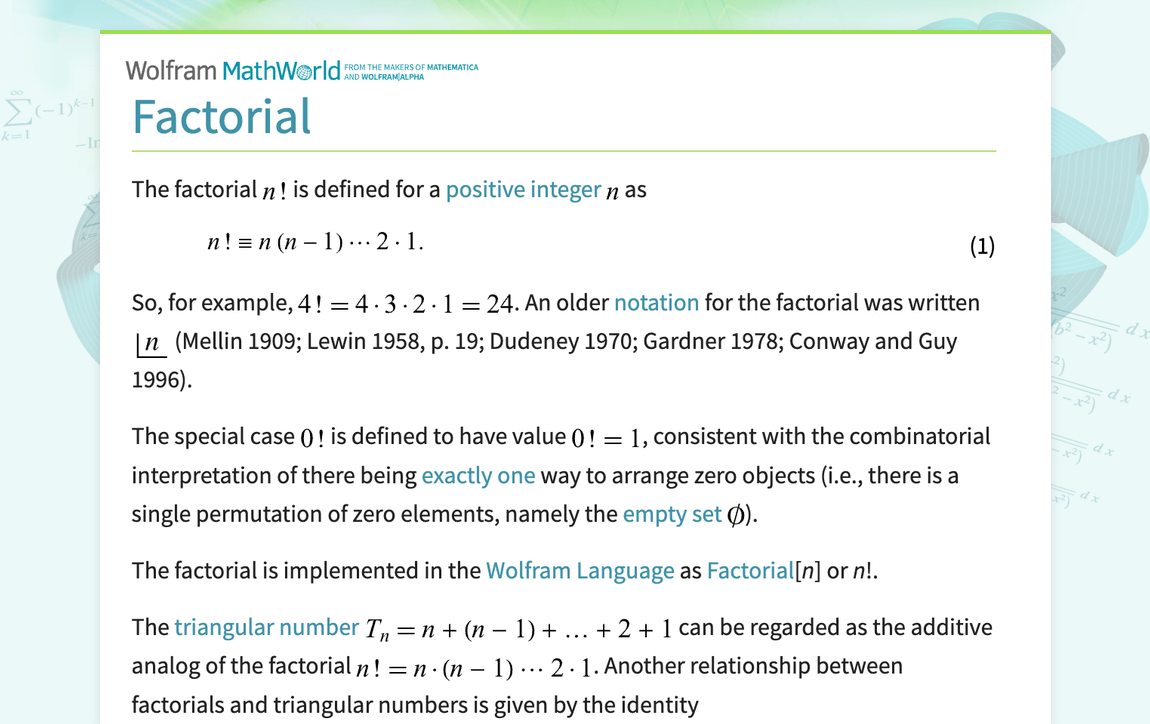
                          I should have added a link to the ever-useful mathworld:

                          The factorial n! is defined for a positive integer n as n!=n(n-1)...2·1. (1) So, for example, 4!=4·3·2·1=24. The notation n! was introduced by Christian Kramp (Kramp 1808; Cajori 1993, p. 72). An alternate notation for the factorial, sometimes known as Jarrett notation, was written (Jarrett 1830; Jarrett 1831; Mellin 1909; Lewin 1958, p. 19; Dudeney 1970; Gardner 1978; Cajori 1993; Conway and Guy 1996). The special case 0! is defined to have value 0!=1, consistent...


                          This has as much detail about n! and Gamma(z) as you'll ever want to know :)

                          Cheers,

                          f

                          Comment

                          • Terry Reedy

                            #14
                            Re: memoize factorial example (was Re: decorators ?)


                            "Tim Peters" <tim.peters@gma il.com> wrote in message
                            news:1f7befae04 120718513e297ae 6@mail.gmail.co m...[color=blue]
                            > Terry, since you're talking about "the rabbit problem", are you sure
                            > you're talking about the factorial example? It sounds like you're
                            > talking about the Fibonacci example.[/color]

                            Of course. 0! is 1 multiplied by nothing (not 0) which is 1, just as n**0
                            is 1 multiplied by n 0 times and hence 1.

                            TJR


                            Comment

                            Working...