documentation error

Collapse
This topic is closed.
X
X
 
  • Time
  • Show
Clear All
new posts
  • bill

    #1

    documentation error

    >From 3.2 in the Reference Manual "The Standard Type Hierarchy":

    "Integers
    These represent elements from the mathematical set of whole
    numbers."

    The generally recognized definition of a 'whole number' is zero and the
    positive integers. That is to say, -1 is not a whole number. The
    documentation ought to replace "whole numbers" with "integers".
  • tiissa

    #2
    Re: documentation error

    bill wrote:[color=blue][color=green]
    >>From 3.2 in the Reference Manual "The Standard Type Hierarchy":[/color]
    >
    > "Integers
    > These represent elements from the mathematical set of whole
    > numbers."
    >
    > The generally recognized definition of a 'whole number' is zero and the
    > positive integers.[/color]

    This term is ambiguous as it seems to be used for both natural numbers
    and signed numbers [1].

    [color=blue]
    > That is to say, -1 is not a whole number. The
    > documentation ought to replace "whole numbers" with "integers".[/color]

    Then you get a circular definition, arguably not very useful.
    Why not simply precise 'signed whole numbers'?


    However, it can be noted that the first instance of such types provides
    the range -2147483648, 2147483647 which cannot be mistaken for natural
    numbers.


    [1] http://en.wikipedia.org/wiki/Whole_numbers

    Comment

    • Reinhold Birkenfeld

      #3
      Re: documentation error

      tiissa wrote:[color=blue]
      > bill wrote:[color=green][color=darkred]
      >>>From 3.2 in the Reference Manual "The Standard Type Hierarchy":[/color]
      >>
      >> "Integers
      >> These represent elements from the mathematical set of whole
      >> numbers."
      >>
      >> The generally recognized definition of a 'whole number' is zero and the
      >> positive integers.[/color]
      >
      > This term is ambiguous as it seems to be used for both natural numbers
      > and signed numbers [1].[/color]

      I cleared this up; now it reads "... set of whole numbers (positive and negative
      ones)."

      Reinhold

      Comment

      • Bryan Olson

        #4
        Re: documentation error

        Reinhold Birkenfeld wrote:[color=blue]
        > tiissa wrote:
        >[color=green]
        >>bill wrote:
        >>[color=darkred]
        >>>>From 3.2 in the Reference Manual "The Standard Type Hierarchy":
        >>>
        >>>"Integers
        >>> These represent elements from the mathematical set of whole
        >>>numbers."
        >>>
        >>>The generally recognized definition of a 'whole number' is zero and the
        >>>positive integers.[/color]
        >>
        >>This term is ambiguous as it seems to be used for both natural numbers
        >>and signed numbers [1].[/color]
        >
        >
        > I cleared this up; now it reads "... set of whole numbers (positive[/color]
        and negative[color=blue]
        > ones)."[/color]

        Consider deleting the sentence in which the Python doc tries to
        define mathematical integers.

        Integers

        [In Python] There are three types of integers:


        --
        --Bryan

        Comment

        • Bengt Richter

          #5
          Re: documentation error

          On Sun, 04 Sep 2005 20:02:10 GMT, Bryan Olson <fakeaddress@no where.org> wrote:
          [color=blue]
          >Reinhold Birkenfeld wrote:[color=green]
          > > tiissa wrote:
          > >[color=darkred]
          > >>bill wrote:
          > >>
          > >>>>From 3.2 in the Reference Manual "The Standard Type Hierarchy":
          > >>>
          > >>>"Integers
          > >>> These represent elements from the mathematical set of whole
          > >>>numbers."
          > >>>
          > >>>The generally recognized definition of a 'whole number' is zero and the
          > >>>positive integers.
          > >>
          > >>This term is ambiguous as it seems to be used for both natural numbers
          > >>and signed numbers [1].[/color]
          > >
          > >
          > > I cleared this up; now it reads "... set of whole numbers (positive[/color]
          >and negative[color=green]
          > > ones)."[/color]
          >
          >Consider deleting the sentence in which the Python doc tries to
          >define mathematical integers.
          >
          > Integers
          >
          > [In Python] There are three types of integers:
          >[/color]
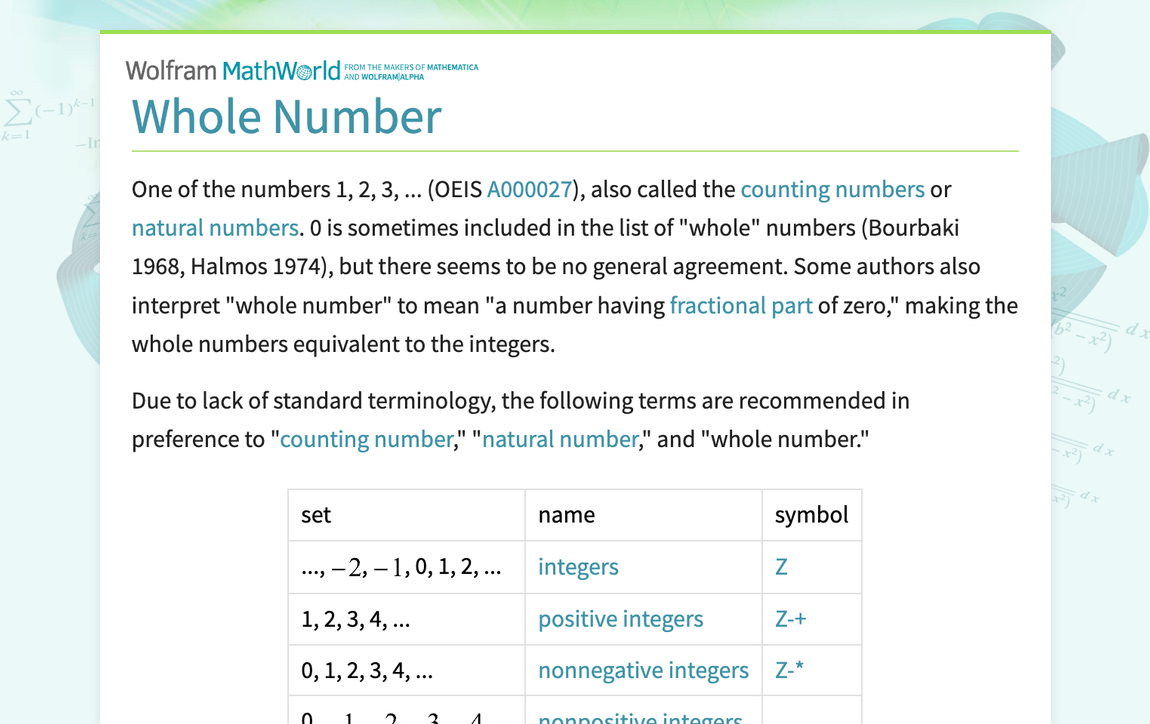
          This is a nice site:

          One of the numbers 1, 2, 3, ... (OEIS A000027), also called the counting numbers or natural numbers. 0 is sometimes included in the list of "whole" numbers (Bourbaki 1968, Halmos 1974), but there seems to be no general agreement. Some authors also interpret "whole number" to mean "a number having fractional part of zero," making the whole numbers equivalent to the integers. Due to lack of standard terminology, the following terms are recommended in preference to...


          Regards,
          Bengt Richter

          Comment

          • Bryan Olson

            #6
            Re: documentation error

            Bengt Richter wrote:[color=blue]
            > Bryan Olson wrote:[color=green]
            >>Consider deleting the sentence in which the Python doc tries to
            >>define mathematical integers.[/color][/color]
            [color=blue]
            > This is a nice site:
            >
            > http://mathworld.wolfram.com/WholeNumber.html
            > http://mathworld.wolfram.com/topics/Integers.html[/color]

            So maybe:

            Integers

            Pyton offers three types of
            <A
            HREF="http://mathworld.wolfr am.com/topics/Integers.html"> integers</A>:


            Or use the Wikipedia ref.

            --
            --Bryan

            Comment

            • Terry Hancock

              #7
              Re: documentation error

              On Sunday 04 September 2005 01:30 pm, Reinhold Birkenfeld wrote:[color=blue]
              > tiissa wrote:[color=green]
              > > bill wrote:[color=darkred]
              > >>>From 3.2 in the Reference Manual "The Standard Type Hierarchy":
              > >>
              > >> "Integers
              > >> These represent elements from the mathematical set of whole
              > >> numbers."
              > >>
              > >> The generally recognized definition of a 'whole number' is zero and the
              > >> positive integers.[/color]
              > >
              > > This term is ambiguous as it seems to be used for both natural numbers
              > > and signed numbers [1].[/color][/color]

              You realize, of course, that "natural numbers" don't include zero. ;-)

              This is a pretty serious nitpick, isn't it? "Integers" is a well defined
              mathematical concept, as well as a pretty well defined (but not coincident)
              computer science concept. It's probably worth mentioning that Python uses
              the *mathematical* definition of "integer" here -- or more precisely that
              Python "long integers" do, while regular "integers" are what are known as
              "long integers" in C.

              Okay. I guess that *is* pretty confusing.

              I think the manual is not so far off since "whole number" makes English
              sense, if not mathematical. Certainly, if I were explaining this to my
              kids I would say "whole" and not "integer" (I at least know they know what
              "whole" means).

              --
              Terry Hancock ( hancock at anansispacework s.com )
              Anansi Spaceworks http://www.anansispaceworks.com

              Comment

              • Dennis Lee Bieber

                #8
                Re: documentation error

                On Wed, 7 Sep 2005 08:31:36 -0500, Terry Hancock
                <hancock@anansi spaceworks.com> declaimed the following in
                comp.lang.pytho n:
                [color=blue]
                >
                > You realize, of course, that "natural numbers" don't include zero. ;-)
                >[/color]
                Tell that to the Ada language standard <G>

                "natural" is 0..whatever, "positive" is 1..whatever.
                --[color=blue]
                > =============== =============== =============== =============== == <
                > wlfraed@ix.netc om.com | Wulfraed Dennis Lee Bieber KD6MOG <
                > wulfraed@dm.net | Bestiaria Support Staff <
                > =============== =============== =============== =============== == <
                > Home Page: <http://www.dm.net/~wulfraed/> <
                > Overflow Page: <http://wlfraed.home.ne tcom.com/> <[/color]

                Comment

                Working...